
Coventry Open 2026 Report
I travelled for my first tournament since I was a junior this weekend, to the Coventry Open. There were four sections and I played in the Under 1750 Intermediate Category, which I was just about eligible for, with a Standard rating of 1733. On the signup list I was seed 1 out of 24, but seed 2, a player called Willem, was rated only 5 points below me.
I’ve never played three classical games in a day before, because my only recent tournament was the Worcestershire Congress which has an unusual format where the first game is rapid, before you get to the longer games. Waking at 5am to get the series of public transport to get to Coventry for a 10am start meant that I was always going to be exhausted. It was held in the upstairs of a leisure centre, with 112 entrants across the sections: far bigger than any tournament that I’ve been a part of before. The venue was nice, but lacked many places to sit between your games unless you wanted to brave the picnic tables in the February weather.
In the first game I was playing seed 14 and I had white on top board. A board I would remain at for the entire tournament and was right next to the door for the loos, which one of the arbiters came and taped something squishy to during the game so that it wouldn’t make a bang. They clearly came prepared for this eventuality. My opponent Jamie (blue hair and a cool Winnie the Pooh/Tarot Card T-shirt) was very friendly and put in a solid opening with a Queen’s Gambit that was accepted on a delay after playing an unusual early a6. As we were playing I noticed that the board next to us was playing essentially the same thing with a slightly different move order. On move 19 my opponent made an inaccuracy that I managed to leverage and from there I kept the pressure on to swap down to a winning endgame. It was a tactical and comfortable game. You can find it and the other four games here: https://lichess.org/study/YY3kInHt/kY1RRyGB
The second game I had black against Matthew, seed 6. Again, he was super friendly and we spent quite a long time chatting about the tournament. He had a big ginger beard and came from Rushall. The game (you can find it in the same study in the link above) started with 1.b3 the Larsen Attack, which is unusual. When I play against an offbeat opening like this I try to adhere to solid development and avoid anything that looks like it might be a trap line. I reasoned that if he was going to play something hyper-modern with an early fianchetto then I should try to establish a solid pawn centre and opted for f6 to stem off his bishop attacks on the main diagonal. In chats with him afterwards he said that most people opt instead for getting a knight on f6 against the Larsen. There was a pivotal centre break on move 8 where I gambited a pawn for taking away his castling rights by swapping queens next to his king. He accepts rather than push his pawn past mine, which in post match analysis we spoke about: I thought he should probably have pushed past, but he wasn’t sure he could hold on to the pawn if he did. Computer analysis agrees with me, but what a computer can defend versus what us humans can defend is obviously different.
The rest of the game was me taking advantage of his central king and his inability to unwrap his pieces. Matt offered a draw on move 17, where he thought there was little to play for with all of the big hitters off the board, but my slight positional advantages (connected pawns and ability to stop his pieces from developing) were enough for me to push on. Move 30 I should have played nxnd2 to swap off all of the pieces and I was considering it, but I lost confidence in my calculations and opted to keep the rooks on the board and claim another pawn. In the end I converted the endgame and he resigned after a blunder. We were both shattered after the game and he opted for a half point bye in round 3, but I pushed on.
The final game of the first day and I was paired against the only other player who was on 2/2 Jason who was nine years old. I’d got lucky that seed 2 had only drawn his second game and several people had taken round 1 off as a Bye for travel reasons, so I only had to win this game to be alone at the top of the leaderboard for the end of the day. I’m always nervous playing children, because their ratings are always much lower than their ability, because they are constantly improving and it takes time for ratings to adjust. Jason wore a Minecraft T-Shirt and had a lot of energy. He did a lot of getting out of his seat and had a bit of trouble remembering to fill in his scoresheet, but he was clearly a strong player.
I had white again and I was pleased when he played the Grünfeld, because I play it myself as black. I have some pet lines against it which are somewhat offbeat and I’ve been playing it for twice as long as my opponent has been alive. On my 23rd move I established a triple cannon of rooks and my queen down the centre and I was gunning for a passed pawn and on move 26 I went down an exchange with a rook for a knight and pawn, but with the compensation of the passed pawn I was aiming for. However my king was horribly exposed and I spent the rest of the game being chased around the board with a series of checks that made me very nervous. Putting it through the engine afterwards there were some massive errors on my part, but eventually a swap off happened and I could eventually get a pawn though. We were both under 10 minutes on the clock by the end and my heart was racing. To be honest, it had been racing all day: it was like my body was in a panic state, but for three lots of three hour games. I hope that in future tournaments I can train myself to be more calm and reserve the panic state for when it is useful in a time scramble rather than being constantly on.
By the end of the day I was on 3/3, with three players Willem, Paul and Shrisha on 2.5/3. I’d booked myself into a hotel near the station, ordered myself an Old Fashioned in the hotel bar, got out my tablet and started analysing my games. A shout out to Scott Oxtoby here, who helped me look through them and also helped me prep some opening theory on what my potential opponent, seed 2 Willem plays as white. If I had him in game 4 he would have white and he plays the rare 1.nc3, the Dunst opening. Scott and I spoke through some options with 1...c5 being a possibility and angling for a sicilian where white can no longer go for c4 for a Maróczy Bind, so Accelerated Dragons are on the table. However I decided instead to go for 1...d5 which has potential to transition into a Scandinavian after 2.e4, but having seen Willem’s game 2 I knew that 2.d4 was more likely, which plays like a Queen’s Pawn game where white can’t play the natural c4 anymore. I also prepped QGA lines in case I saw Willem in round 5 where I was likely to have white.
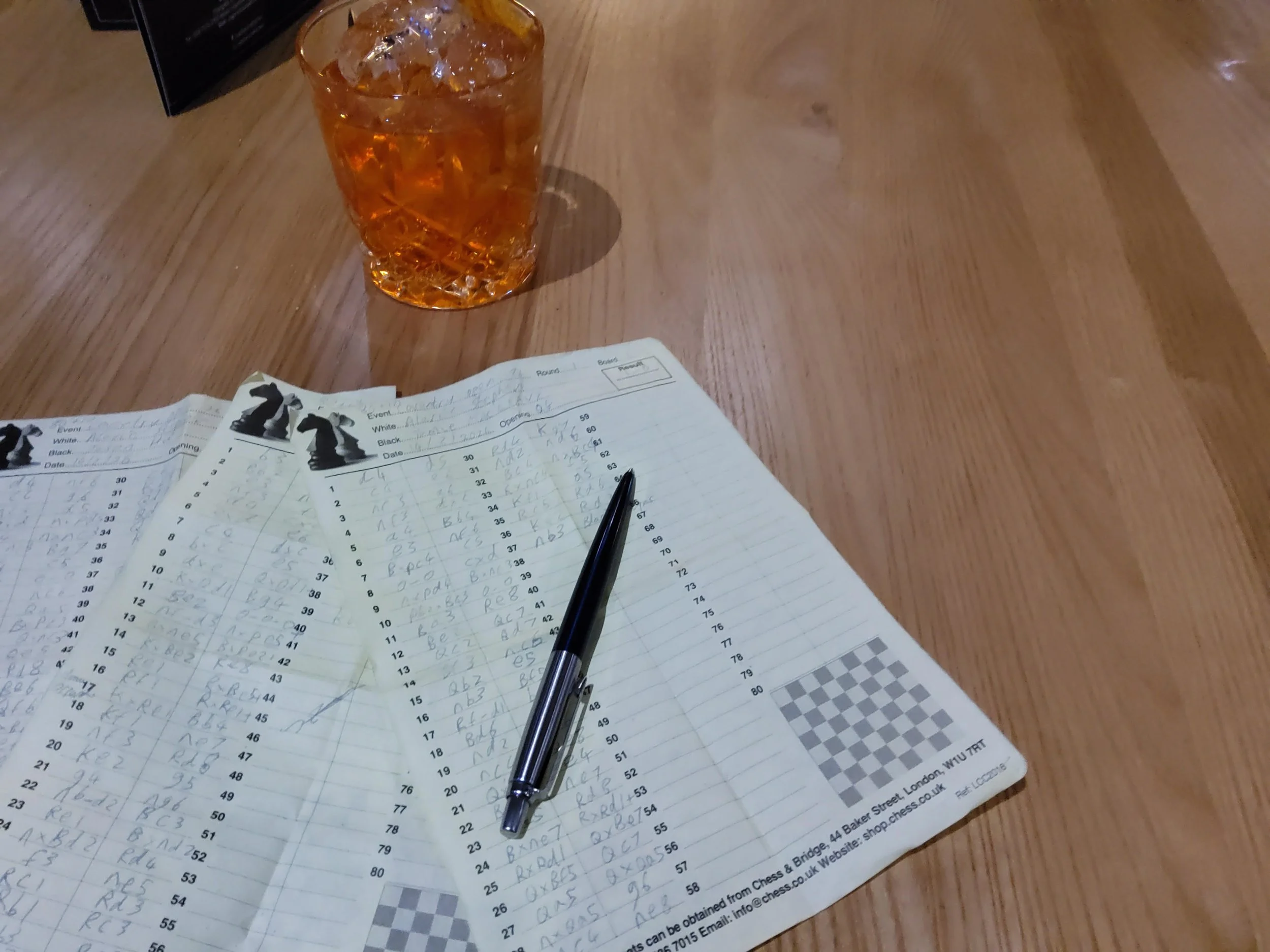
At the hotel bar after the first day
After a night’s sleep I returned to the leisure centre and because I was quite early I settled into what had become my board, working my way through exercises in the book Endgame Strategy by Shereshevsky. I’m actively trying to improve my endgames because I think they are my weak point. Once the pairings were up I was pleased that I was paired against Willem, a Professor of Microbiology. Here was my chance. It went 1.nc3 d5 2.d4 g6 and I was happy for the first ten moves or so however he managed to camp a knight out as an outpost deep in my territory. I’d played basically the same game at some point last year and had managed to get myself out of this last time, so I knew the strategy was to make a queenside push and counter attack. My best wins against strong opponents over the last year have all been ones where I successfully defended a large full scale attack and then once I’ve just about held on then I’ve been able to counter attack. This game was of that form and was my favourite game of the tournament.
Move 22 was a mistake from white which gave me equality and over the next few moves my attack began where white had to give up some material. Going into the endgame I was massively up on material, but there was disaster heading my way. I’d overlooked that my king could be trapped in the corner (which by itself was not an issue because I had pawns that I could march up the board) and that there was a potential perpetual check on my king with the white rook hopping between f7 and f8. It ended in a draw which was devastating, however the two other players on 2.5 going into that round Paul and Shrisha had drawn. That meant that going into the final round I was on 3.5/4 and there were five players on 3/4. Therefore if I won my final game I was going to win outright. A draw meant I was going to have joint first, likely with two other players, and a loss meant I would be overtaken potentially by three others. It felt like I had a horde nipping at my heels. I was going to play for the win.
Having drawn against seed 2, in the final round I was paired against seed 3, Bhavesh. I’d spoken with him earlier in the day and he’d had a difficult tournament playing against exclusively children; which as mentioned earlier is never going to do your rating any good. I think we were both playing for the win, both rejecting trading off queens that were facing each other in the middle of the board (which definitely would have been the better move for him) because we knew that without queens on the board it would have given an increased chance of a draw.
He played the Marshall Gambit against my general Queen’s Gambit plans, which creates open tactical games that feel more like king’s pawn rather than queen’s pawn themes. It was a match where we were both playing aggressively and after doubling up my f-pawns to open up rook threats on his kingside, I had potential for several different devastating sacrifices that would get in to his king which Bhavesh duly had to defend against, but while I kept up the mate threats I also had time for a secondary win mechanism of getting a pawn through the centre. In a last ditch attempt he got his queen and rooks to make an attack against my king, which I underestimated and should have played 26. Kb1 to defend earlier, but it wasn’t fast enough and eventually he resigned once I got my king to safety.
The final scores can be found here https://s2.chess-results.com/tnr1352741.aspx?lan=1&art=4&flag=30&SNode=S0 but in short I won on 4.5/5 with two players Willem and Shrisha (born 2017 and seeded 24th out of 24! I’m so glad that I didn’t have to face her, she was undefeated and only lost points from a half point Bye and a draw in an endgame where she had a pawn and a bishop to nothing, but it was on an edge file and there was nothing she could do to force the win) were on 4/5 to share the second and third prize funds.. My prize was £180! I’ve never won money from chess before. My performance rating for the tournament was 1965! It was also my first FIDE tournament so I should get an official FIDE rating for the first time as well.
Overall I had a great time. I was impressed by the arbiters who were very helpful and I was surprised to recognise a few faces: Joe Friar from Kidderminster who I played with as a junior 20 years ago and who came joint second in the Open, as well as a couple of players from Longbridge, Tom and Craig who I have encountered before in the Worcestershire and Dudley leagues. I came home to Worcester, went straight to the Dragon Pub with my wife and Sean Conway from the club was there. He had already heard of my victory through the grapevine of the Worcester City Chess Club so that was nice. Next time I play in a tournament I should try my way in the Major Section because I think I will have ranked out of the U1750, but for now, I find my brain frazzled and I think I will take a day off from chess.